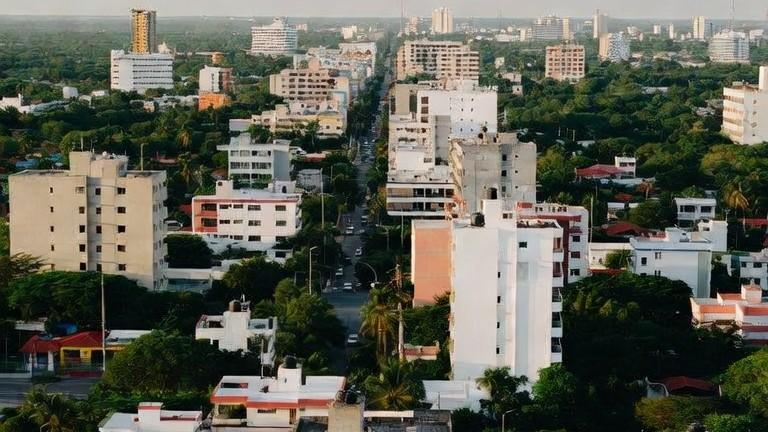
A place does not multiply by a hundred in thirty years through births alone. Six in ten of the people living in the city were born outside Quintana Roo, and that changes how they look for you and why they pick you.
In 1970 the census counted 232 people in Playa del Carmen. By 1990 there were 3,098. By 2020, 304,942.
Births do not do that. Arrivals do.
And there is a number that confirms it: in the 2020 census, 60.9% of the people living in the city had been born outside Quintana Roo. Across the whole municipality the share rises to 64%, the highest in the state.
If you run a business here, that turns into two concrete things.
Your customer does not know what you take for granted
When someone grows up in a city, they pile up thirty years of reference points they do not even notice having. They know where everything is, they know the neighborhood names, and they can place what you mean when you give them a landmark.
Six in ten of the people living here do not have that.
And it shows in small things. When you tell someone you are "on 30th near Constituyentes", the person who arrived two years ago has no idea where that is. When you say "the building where such and such used to be", they never saw it.
That is why a clear address, a map that works and a landmark anyone can find are worth more here than in a city where everyone grew up together.
Your customer does not have here the network they had back home
This is the part you can do the most with.
In the city they came from, that person had a mechanic they trusted, a cousin who knew plumbing, and a friend who recommended a dentist. Here they have none of that.
So they search. They pick up the phone and type what they need, because there is nobody to ask.
And it explains why reviews carry so much weight. Someone without their own network leans on a network of strangers.
For a local business that means one thing: your presence online is not decoration. It is the stand-in for the cousin who fixes things, for all the people who have no cousin here.
And this is changing
The share of people born outside the state has been falling in the city: 67.2% in 2000, 65.0% in 2010 and 60.9% in 2020.
People keep arriving. What is also happening is that those who arrived earlier had children here, and those children did grow up with the local reference points.
It is a plausible explanation and it fits the numbers, though the census does not measure the cause.
For a business that matters because the two ways of looking things up now coexist: the person who arrived two years ago picks up the phone, and the one born here asks somebody first.
The market the data does not see
And there is one last thing worth keeping in mind.
The census recorded 9,587 people born in another country in the municipality in 2020, and the Encuesta Intercensal estimated 12,527 in 2025. A 31% rise in five years.
But the Argentine consul, Lautaro Filchtinsky, estimated in October 2022 that between 20,000 and 25,000 Argentines live here. From his country alone.
The two figures measure different things. The census counts whoever lives here habitually and says so in their household. A consular estimate includes the people who come and go.
And it is worth knowing that the Encuesta Intercensal, the mid decade survey run by INEGI, Mexico's statistics institute, carries wide margins at the municipal level: the one for Playa del Carmen runs from 321,000 to 467,000 residents.
What that leaves you is a useful warning: part of your market shows up in no public figure at all, because it does not stay long enough to be counted.
If your business depends on that profile, the official numbers will understate how big your market is.
What to do with all this
Write for someone who does not know the city. Full addresses, landmarks anyone can place, and a location that works in a phone map.
Mind what people find when they look you up, because they are going to look you up more than they are going to ask around.
Ask for reviews. For someone without a network here, that is their network.
Playa del Carmen was built by people from somewhere else. That explains a good part of how business works here, and there is more to do with that than it seems.
At Kiin Hub we have the Mesa Kiin: putting your case in front of people who know different things. Tax and accounting, labor, value proposition, process and technology. If you want to look at who you are talking to and how, bring it.
Data: INEGI, Population and Housing Censuses of 1970, 1990, 2000, 2010 and 2020, and the Encuesta Intercensal 2025. The Argentine consul's estimate is from October 2022 and was published by Clarín on February 21, 2024.
Share this article