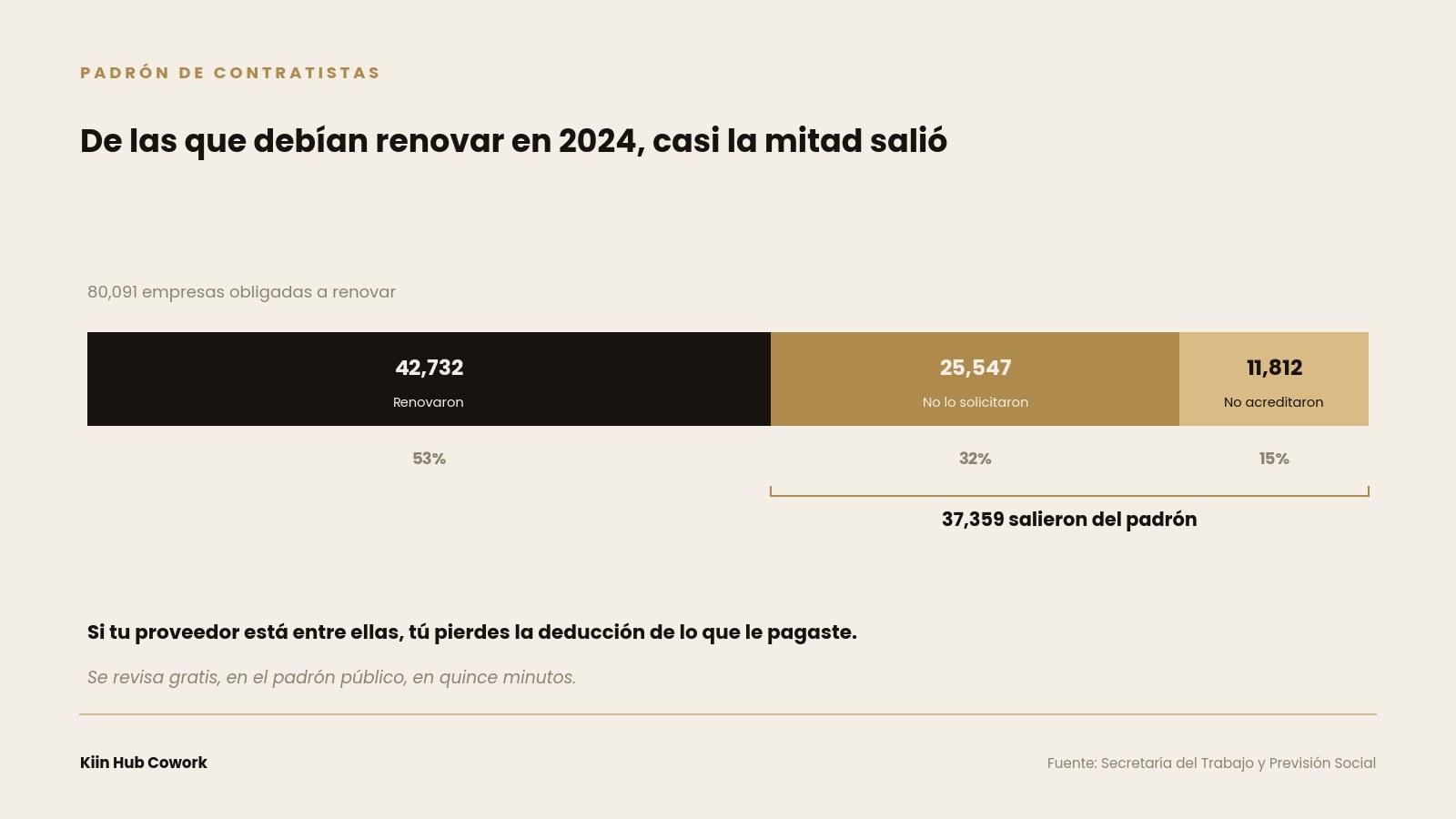
Almost half of the companies that had to renew in 2024 dropped out of the registry. If one of your suppliers is among them, the problem is yours, and you probably didn't hear about it.
If your business hires cleaning, security, landscaping, maintenance or outsourced staff, this applies to you.
Those suppliers need to be registered with the Labor Ministry's registry. And the requirement isn't only theirs: if you pay them while their registration isn't current, you lose the deduction for that expense.
There's no cap. If you paid half a million pesos over the year to a cleaning company without a registration, that half million stops being deductible for ISR, Mexico's income tax, and you can't credit the IVA, the value added tax, charged on it.
That has always been the case. What changed is how many suppliers are dropping out.
What happened to the registry
In 2024 the first renewal cycle came due. Of the 80,091 companies that had to renew their registration, 42,732 did. The rest didn't: 25,547 never even applied, and 11,812 applied but didn't meet the requirements.
In other words, almost half of the companies that were required to renew dropped out of the registry in that cycle.
And it kept going. The registry once had around 160,000 companies. By February 2025 it was at 139,085, according to statements by the head of the Labor Ministry's Decent Work Unit. Specialized publications put it considerably lower in 2026, although there's no recent official figure to confirm it.
What matters for you isn't the exact figure. It's that tens of thousands of companies stopped being registered, and many keep operating and invoicing as if nothing happened.
Why you probably didn't hear about it
Almost no business checks this more than once.
The usual thing is to ask for the registration when you hire the supplier, file the paper in a folder and never look at it again. But registrations expire, get canceled over unmet obligations with the SAT, Mexico's tax authority, or with the IMSS, the social security institute, or simply don't get renewed.
And nobody tells you. Not the supplier, who often hasn't found out either, and not the authorities.
The day you find out is usually too late: during an audit, or when your accountant is putting together the annual return and finds invoices they can't deduct.
How to check it, free and in fifteen minutes
This doesn't require hiring anyone.
One. Make a list of your service suppliers. Not every supplier counts: only the ones that put staff to work at your premises or under your direction. Cleaning, security, maintenance, administrative staff, kitchen. If they sell you a product and leave, it doesn't apply.
Two. Look them up in the public registry. The Labor Ministry has an online search tool where you enter the supplier's name or RFC, their tax ID, and it tells you whether their registration is current. It's free, it's public and you don't need an account.
Three. Note each one's expiration date. Registrations are valid for a set period and have to be renewed. If you know when one expires, you can give the supplier a heads-up in time instead of finding out afterward.
And four. Repeat it every month. Once the list is made, checking ten suppliers takes less than fifteen minutes.
That's all. There's no trick.
What to do if one isn't there
This is where it pays to keep a cool head.
Don't pay until they fix it. It sounds harsh, but it's the only thing that protects you. And the supplier has every reason to fix it fast if getting paid depends on it.
Ask them in writing what they're doing about it. Sometimes it's paperwork in progress and gets sorted out in weeks. Other times the supplier has already decided not to renew and hasn't told you.
And review what you paid them this year. If there were payments during a period without a current registration, that's already in your books, and your accountant should know before the annual return, not after.
The step almost nobody takes, and it works
Send an email to all your service suppliers saying that from now on you'll ask for proof of current registration every quarter, and that it's a requirement for processing payments.
Three things happen when you do.
The ones who are up to date send you the document without a fuss. The ones who aren't get to work on it. And the ones who already dropped out of the registry and don't plan to come back tell you so, which is exactly what you need to know before you keep paying them.
One email. And it saves you the awkward conversation later.
What this isn't
It isn't a big-company issue. A restaurant that hires a cleaning service, a firm with a courier service, a small hotel with landscaping: they're all in the same situation.
It isn't paperwork for you, either. You don't have to register for anything. You just have to check that whoever provides the service is registered.
And it isn't urgent in the sense that something will happen tomorrow. It's one of those things that doesn't hurt until it does, and when it does, a year of invoices has already gone by.
Where to start today
Open your list of suppliers and mark the ones that put people to work for you. There are probably fewer than you thought.
Those are the ones to check. And the first check takes the longest, because you have to build the list. After that it's fifteen minutes a month.
At Kiin Hub we have the Mesa Kiin: putting your case in front of people who know different things. Tax and accounting, labor, value proposition, process and technology. If you're not sure which of your suppliers this applies to, bring it and we will go through it.
Share this article