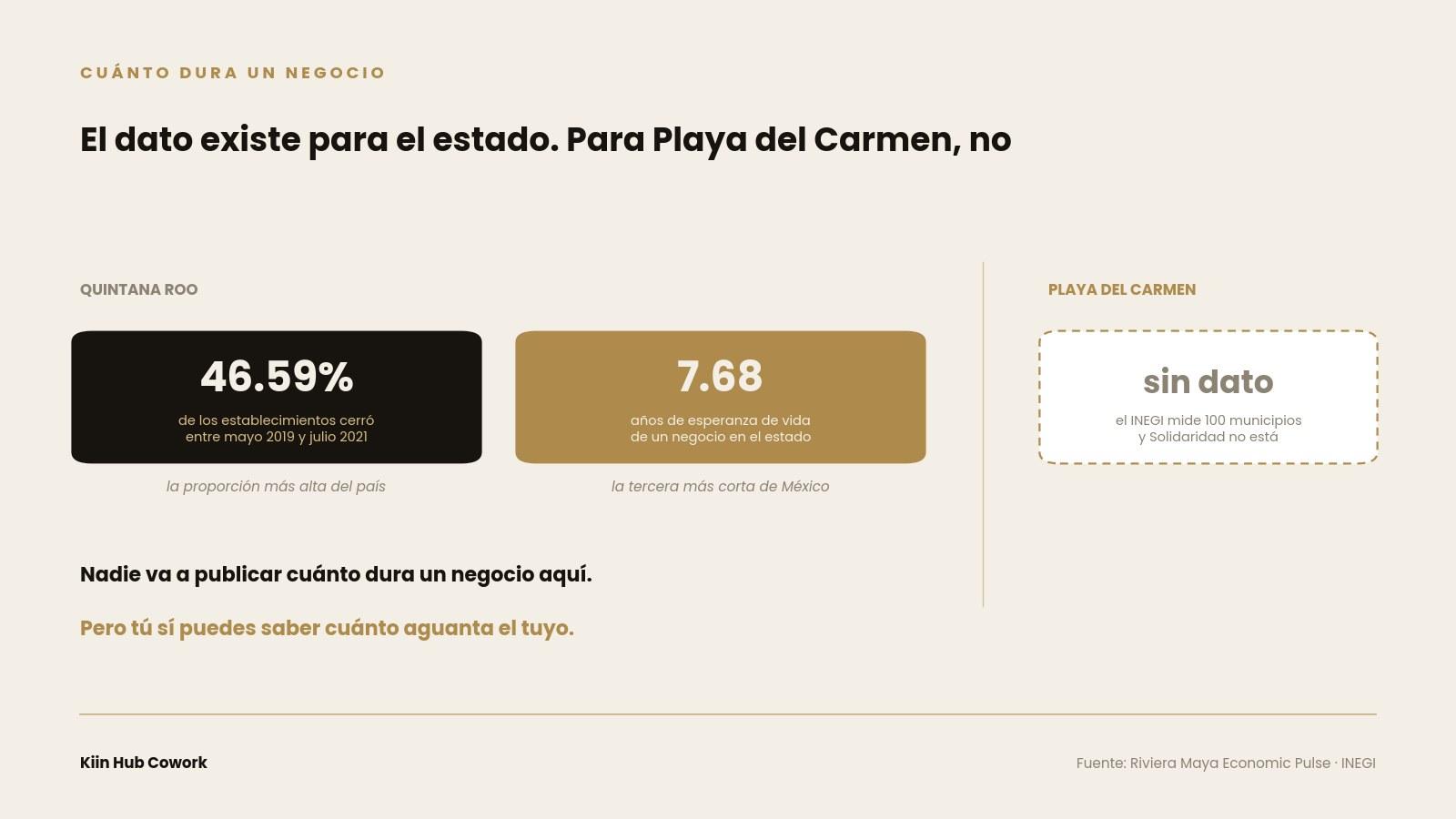
The figure exists, though nobody measures it for Playa del Carmen. And what separates a business that lasts from one that doesn't tends to be less glamorous than it sounds.
Between May 2019 and July 2021, 46.59 percent of the business establishments in Quintana Roo shut down for good. It was the highest share in the country.
There is another figure that goes with it: the life expectancy of a business in this state is 7.68 years, the third shortest in Mexico.
Before drawing conclusions, two warnings worth keeping in mind. The first period covers the pandemic, so it is not a normal stretch of time. And the second figure comes out of a 2019 census, which means it already has seven years on it.
But there is something you can say without qualifiers: running a business here is harder than in most of the country. That is not a perception. It has been measured.
The figure that does not exist
Here comes the uncomfortable part.
The INEGI study that calculates how long a business lasts goes all the way down to the municipal level for a hundred municipalities in the country. Solidaridad, the municipality Playa del Carmen belongs to, is not one of them.
Which means nobody knows how long a business lasts in Playa del Carmen. There is no official count of how many open, how many close, or how long they hold on.
And the measurement that did produce results by state stopped publishing them in its most recent edition. In the state where the most businesses were closing.
So whoever operates here decides without a basic reference point that other cities do have.
What can be known
If the aggregate figure is missing, what is left is looking at what the businesses that have been running here for years have in common. And what shows up is not glamorous.
They do not depend on one season. The ones that survive slow Decembers are the ones with something to sell in September. A monthly contract, a repeat client, a service that does not depend on a plane landing.
They do not depend on one client. When 40 percent of the billing comes from one place, that place decides whether the year was good. And in this region the big clients change hands, close down or move on more often than in other markets.
They know their number. They know how much they have to sell to stop losing money, so they know whether a month was bad or only felt bad. That difference decides whether you hire or not, whether you hold on or not.
And they do not mistake a good month for a trend. A strong December covers December's hole. It does not change January's arithmetic.
What tends to sit behind the ones that close
Worth saying carefully, because closing a business almost never has a single cause. But there are patterns that repeat in this region.
Growing the fixed cost before the sales. Renting bigger, hiring ahead of time, committing to twelve months on the strength of three months of sales. In high season that feels prudent. In May, it does not.
Living off an anchor client. Plenty of service businesses in the Riviera start out serving one hotel, one developer, one chain. When that client restructures, switches suppliers or closes, the supplier goes down with it.
And not telling cash apart from profit. Money in the account does not mean the month closed well. Often it is a deposit that is already spoken for.
What you can do with this
Three things, and none of them costs money.
Work out how much you have to sell to break even. It takes fifteen minutes, splitting your expenses into fixed and variable. That number decides every other decision in the business.
Check how much your biggest client weighs. If it is over 30 percent of your billing, finding the next one stops being optional.
And build something that does not depend on the season. A recurring service, a monthly contract, a client from another city. It does not have to be big, it has to be steady.
Why the missing figure matters
When there is no measurement, everything gets explained with impressions. And the dominant impression in this region is that the business that closed was badly run, or arrived at the wrong moment, or failed to adapt.
Sometimes that is true. But without data there is no way to tell how much of it is the business and how much is the setting. And that difference matters, because if the problem is the setting, squeezing harder does not solve it.
What can be done meanwhile is to measure inward. Your own number, your own client concentration, your own dependence on the season.
Nobody is going to publish how long a business lasts in Playa del Carmen. But you can know how long yours holds.
The closure and business life expectancy figures come from analysis published by the Riviera Maya Economic Pulse, sourced from INEGI.
At Kiin Hub we have the Mesa Kiin: putting your case in front of people who know different things. Tax and accounting, labor, value proposition, process and technology. If you want to look at how exposed your business is, bring it and we will go through it.
Share this article