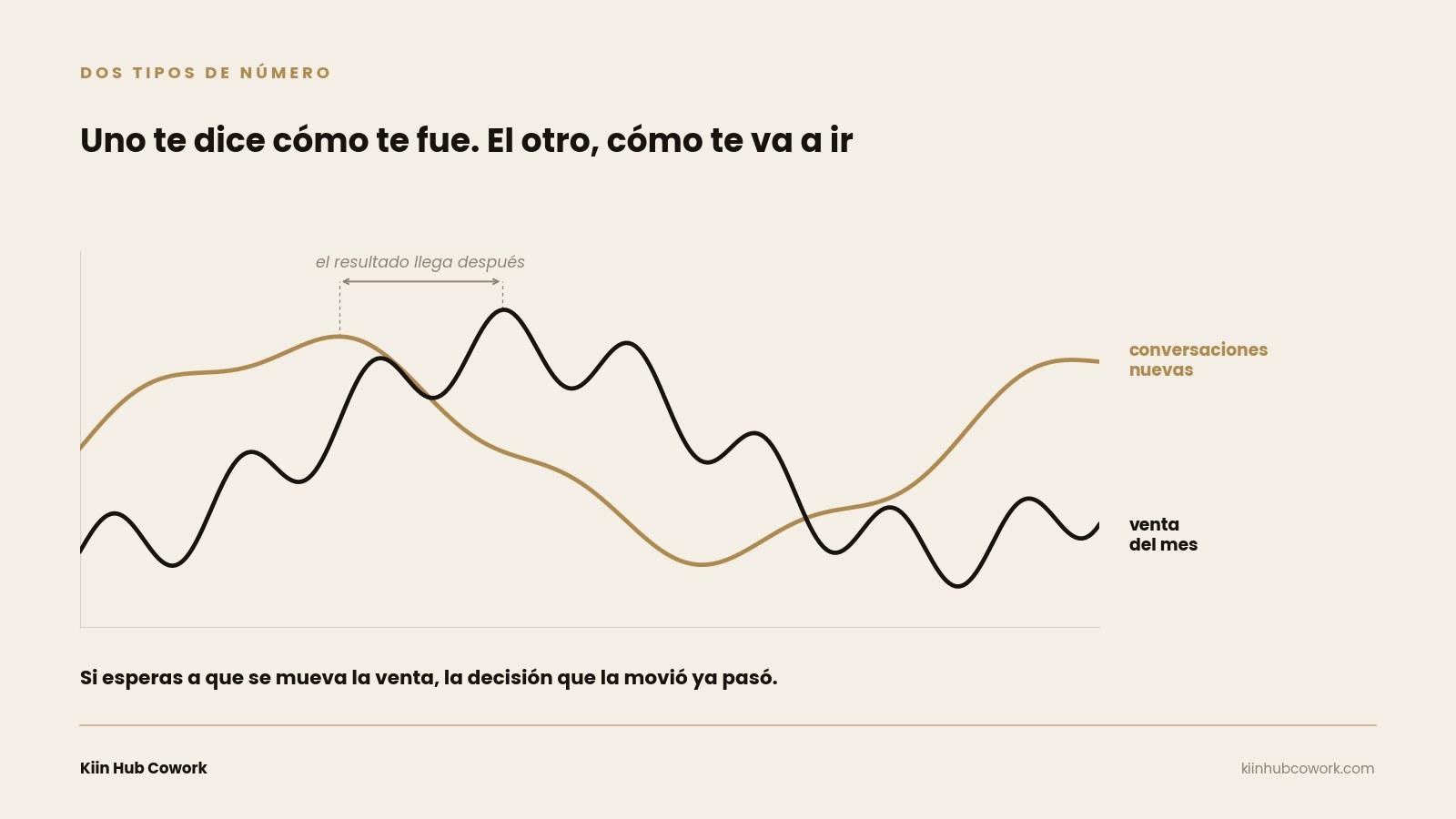
Almost all of us track the same thing: what came in today, what came in this month. Those numbers tell you how it went. There are others that tell you how it's going to go, and those are the ones almost nobody keeps.
Ask anyone running a small business how the month is going and the answer will be a sales figure.
That is fine, and you need it. The problem is that the figure already happened. By the time you see it, the decisions that produced it were made weeks or months ago.
And if it is the only number you look at, you are driving by the rearview mirror.
Two kinds of number
The ones that tell you how it went. Sales for the day, invoicing for the month, profit for the quarter, active customers. They arrive late by definition: they are the result of what you already did.
And the ones that tell you how it's going to go. How many new conversations you had, how many quotes you sent, how many people walked in, how many customers came back.
That second kind is the interesting one, for two reasons.
They happen before the result. If you had no new conversations this week, you already know something about next month, even if today's sales were good.
And they are yours to move. You cannot decide to sell more. You can decide to send five quotes.
What they look like in different businesses
If you sell services: quotes sent, conversations with new prospects, proposals still open, and how long you take to answer when someone asks.
If you have a storefront: how many people come in, what share of them buys, how many are new and how many came back, and how much each one spends on average.
If you sell to companies: how many customers account for more than 20% of your invoicing, how many contracts expire in the next six months, and how many different customers your revenue came from this quarter.
And in any business: where each new customer came from. That one is the cheapest to keep and the one most people skip.
How to pick yours
You do not need fifteen. You need three or four that meet two conditions.
That you can move them. If the number depends on the weather, on the season or on somebody else's decision, it does not work as a guide. It works as context.
And that they happen before the result. The test: if this number moves this week, will it show up in sales a month or two from now? If the answer is yes, it is one worth keeping.
That rules out half of what usually gets measured.
The trap of measuring what is easy
Some numbers get tracked because they are within reach, not because they help. Followers, page visits, likes on a post.
They are not useless, but they almost never run ahead of sales. A business can double its followers and not sell a peso more.
The test is simple: if this number goes up and sales do not, would you change anything? If the answer is no, it is not something to steer by, it is decoration.
Why this matters more in the low season
When sales drop, everyone stares at sales. And sales will not tell you what to do: they only tell you that something is not working.
The numbers that run ahead do tell you where. If new conversations dropped, the problem is in finding people. If the conversations are still there but they do not close, the problem is the proposal or the price. If they close but you invoice less, the problem is the size of the sale.
Three different diagnoses, with the same sales figure underneath.
And the ones that matter three years out
There is a third kind almost nobody keeps, and it is the one that says whether the business will still be there in the long run.
How much your largest customer weighs. If it is more than 30%, you do not have a business, you have a contract.
How much of your revenue is recurring. Meaning how much comes in without you having to sell it again.
How much of the business depends on you being there. If you leave for two weeks, what stops?
And how many different customers brought you revenue this year. If last year it was twelve and this year it is seven, that matters even if you invoiced the same.
Those four do not move from one month to the next, and that is why nobody checks them. They are also the ones that say the most.
How to start without making it complicated
One sheet, four columns, a look at it on Mondays.
Pick two of the ones that run ahead and that you can move this week, and two of the long run ones, even if you only check those once a month.
And if you are going to keep a single one to start, make it where each new customer came from. Three months of that will tell you more about your business than a year of checking daily sales.
At Kiin Hub we have the Mesa Kiin: putting your case in front of people who know different things. Tax and accounting, labor, value proposition, process and technology. If you want to define what to measure in your business and you're not sure where to start, bring it and we will work it out.
Share this article