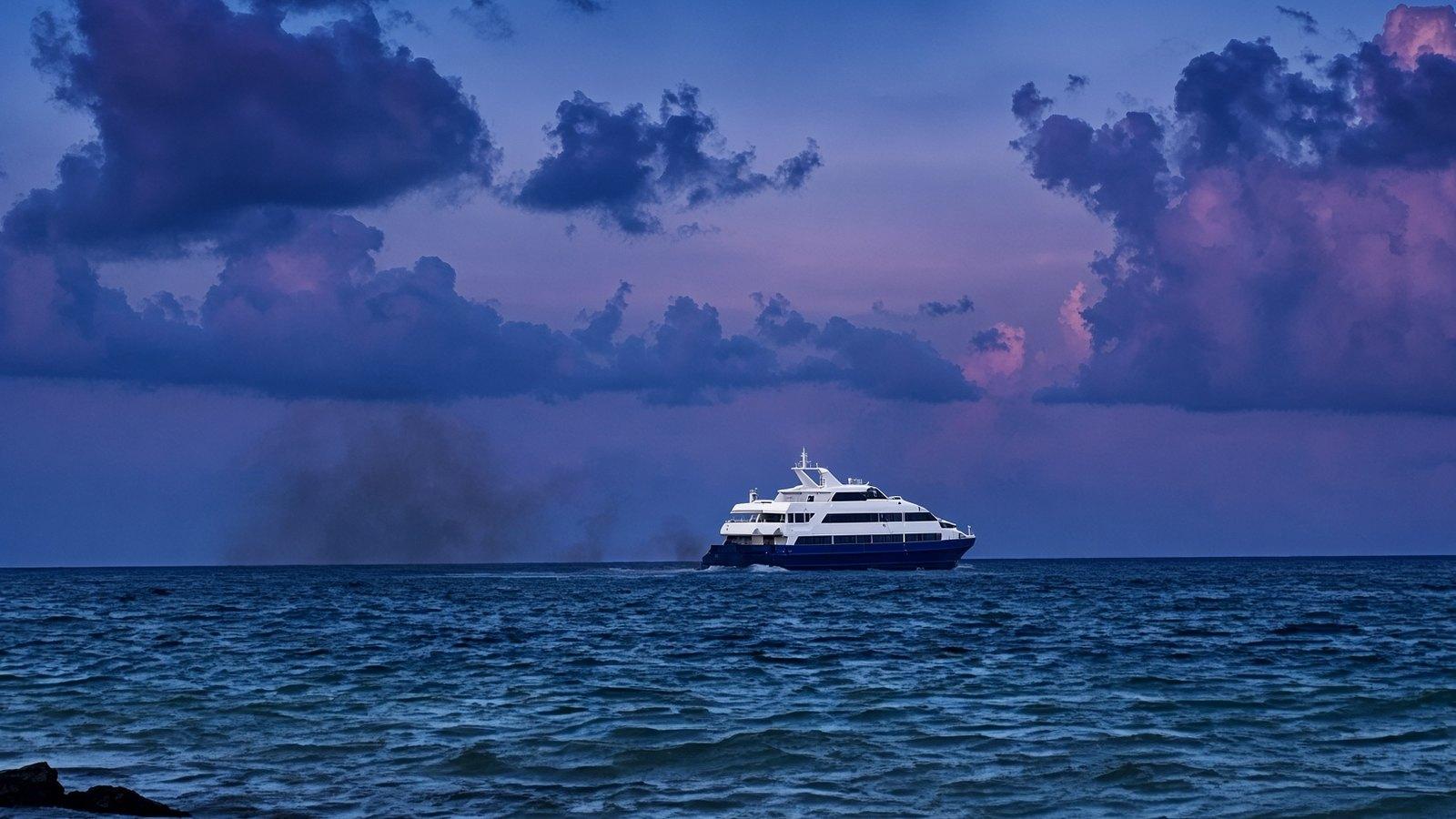
In 1970 someone decided the crossing to Cozumel should leave from Playa del Carmen. Today that route carries more than three and a half million passengers a year. It is worth seeing how it started.
The crossing to Cozumel is now one of the busiest sea routes in the Mexican Caribbean. Between January and November 2025 it carried more than three and a half million passengers, almost 10% more than the year before. Three operators run it, and the newest one came in with a declared investment of 315 million pesos.
But there was a time when it did not exist.
The crossing left from Puerto Morelos and took too long. And someone who grew up in Cozumel realized there was a shorter way to do it.
He started by buying where nobody wanted to
Fernando Barbachano Herrero grew up in Cozumel. In 1966, at sixteen, he bought beachfront in Playa del Carmen.
At that point the town had around twenty one families. It was not a destination, there was no decent road, there was nothing to suggest anything was going to happen there.
What there was, was geography. Playa del Carmen is closer to Cozumel than Puerto Morelos, and that was never going to change.
That is the first lesson and it is less obvious than it sounds: what makes a place valuable is not always what is there, but the position it holds relative to something else.
He identified a concrete problem
In 1969 he created Transportes Turísticos del Caribe and designed the route from Playa.
The problem he solved was not abstract: the crossing from Puerto Morelos took too long. That is a specific, measurable annoyance that people suffered every time they wanted to go to Cozumel.
He did not invent a need. He shortened a trip that already existed.
And there is something there for any business: most opportunities are not in creating something nobody has seen, but in making faster, cheaper or easier something people already do grudgingly.
He put in his own money
In 1970 he started regular crossings with the Tropic Breeze, a boat he bought in Pennsylvania with his savings.
There was no bank loan, no investors, no support program. It was a twenty year old buying a boat in another country with what he had put aside.
That has two readings and both are useful.
The first is that he started with what he could carry, with no debt forcing him to grow faster than the market allowed.
The second is that he took on all the risk. If the crossing did not work, he lost his savings and there was nobody to turn to.
That is the difference between starting with your own capital and starting with someone else's: the first lets you decide, the second lets you share the blow.
He created the market, and then the others arrived
Nine years later, on January 6, 1979, he opened a Playa to Cozumel flight at 98 pesos. In nine months it carried a hundred thousand passengers.
A hundred thousand people in nine months, in a town that thirteen years earlier had twenty one families.
That is not finding a market: it is building one. People were not crossing to Cozumel from Playa because they could not. Once they could, they did.
And once the market existed, others came to compete for it. Three operators run that route today, one of them with an investment of 315 million pesos.
Whoever gets there first rarely keeps it all. But without him there would be no market to compete for.
He knew when to get out
In 1983 he sold his businesses in Playa del Carmen.
Thirteen years after starting the crossings, and four after the passenger record on the flight.
That sale included the project that would later be called Playacar, which we covered here.
He sold while the business was working, not while it was falling apart. And that is a decision almost nobody makes in time.
The usual thing is to hold a business until it stops paying, and by then it is no longer worth what it was. Getting out at the high point means recognizing that your part of the work is done, and that what comes next is a different kind of business that may not be yours.
What he built in thirteen years went on existing without him for forty three more.
What this says to anyone starting today
The four decisions in that story belong to any business owner, not to a ferry operator.
Look for the problem people already suffer. Not the one you find interesting to solve. The crossing from Puerto Morelos took too long and everybody knew it.
Look at the position, not just the place. Playa del Carmen was not worth anything for what it had, it was worth something for where it sat relative to Cozumel. Your business may be in the same situation and not have noticed.
Start with what you can afford to lose. A boat bought with savings is slower than one bought with debt, and it is the one that lets you keep deciding.
And be clear about which part is yours. Opening a market and running one at scale are two different jobs. Knowing which one is yours keeps you from staying in the one that no longer is.
Why tell it here
In this city it is easy to feel that everything important already happened, that the ones who came first took what was good, and that all that is left is competing in what already exists.
The story of the crossing says otherwise. In 1966 nobody wanted land in Playa del Carmen. In 1970 the route to Cozumel did not exist. And the person who saw both things was sixteen years old, and then twenty.
He did not see the future. He saw a distance that could be shortened.
And that is still out there, in this city and in any other, for whoever takes the trouble to look.
At Kiin Hub we have the Mesa Kiin: putting your case in front of people who know different things. Tax and accounting, labor, value proposition, process and technology. If you have an idea and want another set of eyes on it, bring it.
Sources: Fernando Barbachano Herrero's account in Yucatán Today (January 15, 2022) and passenger figures from APIQROO.
Share this article